

Rising sun
Takes the mist away
Boats launch
Laughing and joking musselmen start work early.
My auntie points to the tide going out.
Her weather-beaten face smiles towards the rising sun.
Her wrinkles are like sunrays; light from her eyes warms me up
at my first morning as the mussel gatherer.
I am eight years old in this photograph.
Conwy town
My family nest
Life flows as the river
(Tamara Rogers)
It's very cold. The sun has yet to rise, but there's a pinkish glow in the sky. Still glazed and mute with sleep, I nod a greeting to the milkman as he manoeuvres his float down the cobbled hill of the dream-bound town, leaving a sound of clinking milk bottles in his wake. Down on the quay, seagulls mewl like hungry cats, while the little boats lying at anchor turn to face the fast-running tide. All at once, I am hit by the familiar salt, fish and oil tang of the river, and the sound of slurping and sucking as it laps against the harbour walls and licks the hulls of docked boats. The launch and mussel boats are already at the slipway loaded up with rakes and rope baskets. Voices carry across the water. The lads' heads are wreathed in plumes of steam as their hot laughter meets the frosty air.
a full, faded moon
the cry of oystercatchers
light on the water
(Beth Bithell)
Introduction
'You could hear Gwladys singing “Jerusalem” all across the harbour.'
This simple sentence with its powerful image introduced me to the life of the mussel-pickers of Conwy. I heard it while interviewing retired musselman John 'Dunphy' Roberts at his home in Llandudno Junction, as he told me the story of his aunts Gwladys and Nell, who loved to go mussel fishing with him.
The encounter typified for me the natural, fond recollections of the old life and its events for all the musselmen I met and talked to while collecting their stories for this booklet.
Another morning when I had wandered over to Benarth beach, where I'd first chatted to a worker from the old mussel-purification plant, I found Martin Parry working in his boat, 'Welsh Maid'. I knew of Martin from conversations with Tom Jones at Conwy Mussels on the quay: Martin, Francis Smith and Trevor Jones, Tom's Dad, had set up that business after the closure of Benarth by the Ministry of Agriculture and Fisheries.
Martin, in a striped fisherman's jersey, poked his woolly-hatted head out of the boat to talk against a cold blue February sky about the generations of his family who had been fishermen. His father, grandfather and his mother's family were all fishing people, and Martin was born in Conwy's Wind Street. Martin, who now fishes for lobsters around Llandudno, explained how Conwy Council had helped the men to begin trading in the building where Tom now works from. Martin also passes on his fishing expertise to students at Llandrillo College, and remembers the vivid life of Conwy's fishing heyday. He thinks there are now only about twelve mussel-fishing licence-holders in the town, and hopes that Tom can keep the industry viable as Conwy mussels are of such fine quality.
Comradeship, family life, acceptance and a wry wit are all characteristic of these men – and although I found only one living female ex-mussel worker, I discovered that the women who fished had been every bit as hardy and as conscientious as the men, as they worked from the shore, picking and sorting the haul. Gwladys Roberts and her sister Nell were two of these. At Conwy Archives I came across an old Daily Sketch full-page article of 1938 – 'A Glimpse of the Conwy Colony of Mussel Fishers' – with a browned and faded photograph of the women, in their oilskins and peaked caps; Nell looking out to sea and welcoming the boats home and Gwladys beaming into the camera.
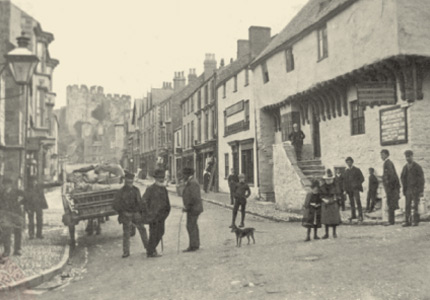 © Conwy Archives Service
'Miss Gwladys Roberts, a well-known Eisteddfod singer, always greets the returning fleet with a song' runs the caption, adding the intriguing and topical snippet that 'the mussel fishers had come into the news a few days ago, when, in answer to an appeal, Mr Lloyd George hurried to the town and met a deputation. They feared their living may be affected if a new road is built along the waterfront, and Mr Lloyd George promised his support'.
The piece adds a description of the way the mussels were washed in tanks, by means of a high-pressure hose, before being sterilised. An atmospheric photograph shows fishermen coming home 'with the long-handled rakes with which they gather the shellfish'.
There is more comment on this development in Michael Senior's booklet 'Crossing the Conwy' (Gwasg Carreg Gwalch, 2008), which mentions the planned road scheme of 1938 which would have destroyed Conwy as a harbourside town, and the great concern as fishermen feared they would lose their livelihood if the quay were lost. He comments how the mussel industry was then a more significant part of the town's economy, with ninety-six licensed fishermen. Lloyd George agreed he was concerned for their jobs, but the current alternative – a road through the town centre – was worse. Plans continued to change until those for an immersed tube tunnel were set forth in 1988, and the project was completed in 1989. It is fascinating to note that even with all the upheaval of the tunnel workings, mussels were still filtering cloudy water until it was clean. The quote comes from Ronnie Ells:
'The Colcon Project posed what seemed a major problem – due to the dredging of the river there were very high levels of suspended solids, and at first it was thought impossible to purify the mussels in that dirty water. However, it was decided to give it a try, and looking at the effects, it soon proved hopeful; the mussels filtered the cloudy water to normal in a very short time. The health checks were OK, and we even started to use mussels in the labs to clean water which no known filter could handle!'
Early on in the project I met up regularly with a group of local volunteer writers, keen to distil the history and anecdotes we were gathering into poems and stories, and some of these are found scattered through the booklet.
As I talked to more musselmen, I learned more about the fishing techniques. The original pitch-pine rakes were invented by twelfth-century Cistercian monks, but I learned that the modern-day iron ones were made by men like Peter Higginbottom, whom I'd talked to at St John's Methodist Church's coffee morning. I learned how when the rake was full it would be turned around to empty the catch into the boat, and Peter described how the rakes would often be covered with ice on winter nights. That image was repeated many times during the course of my interviews.
I would hear tales from men such as Ken 'Rimmer' Hughes, who had started to mussel fish from early boyhood, and who would go out in wind, snow and rain without a lifejacket at fourteen, learning to handle the vagaries of weather as readily as hauling up the catch. I came to realise that a handful of Conwy families had been at the heart of the industry in its prime, and the same names emerged in every conversation – those of the Jones family, the Roberts, the Hughes and the Cravens. Many were connected by friendship or seem to have married into other mussel-fishing dynasties – Ken 'Rimmer' Hughes, for instance, married Denise, who was one of the Cravens. It seemed that their ancestors had come into Conwy on boats and ships for shelter, and had settled and married in the town.
When I asked Johnny Roberts to suggest the names of other musselmen I could talk to, many sprung to mind.
'There's Bryn Hughes, on the quay – and Tim, his son… Roland Hughes, who's passed away now, was their dad. And, of course, Trevor Jones – Tom, of Conwy Mussels on the quay, is his son.'
So I began to discover links and knew that there would be many different stories to tell, or perhaps several versions of the same. I'd known about Gwladys and Nell, for instance, from chatting to Betty Pattison, OBE: they were her maiden aunts, and Betty had been the first to tell me about Gwladys's singing, and how she'd worked with the mussels to pay for her music lessons. When I went to talk to Betty's brother, John 'Dunphy' (as he'd grown up on Dunphy's Corner in Conwy), up popped those memories of Nell and Gwladys in yet another context.
During my interview with Brian 'Porth Bach', mention was made of Ronnie Ells, who seemed to be the walking encyclopaedia of all I needed to know about the mussel-purification tanks. All I knew at that point was that the tanks no longer existed, but in their day had been vital in maintaining the necessary standards of hygiene in the booming mussel industry. One morning I wandered along to Benarth and asked three men on the little beach, who were working with cranes and pontoons and scrap metal, if they could could tell me where the tanks had been.
'Here's your man!' said one, and there was the famous Ronnie Ells, happy and ready to show me the site of the long-gone tanks, to explain the purification processes, and to vividly bring to life for me the scenes of bustle and camaraderie that had once held sway here on the shores of the river.
I found these stories fascinating and heart-warming. A romantic picture was emerging of a seaside town whose industry was ruled by tides, where one's auntie would come knocking at the door in the early hours to get you to sea; where hundredweight hessian sacks full of mussels and fastened with a lead seal would be carried to market, where the lad who grew up to be Johnny Roberts of the Gallery Café might discover his 'brother' was in fact an uncle – 'but no one thought to mention it!'
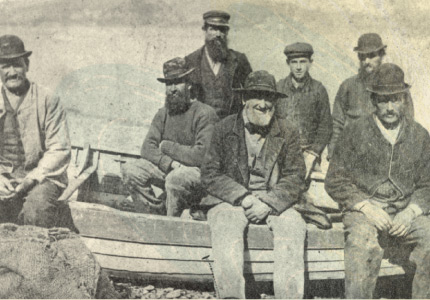 © Conwy Archives Service
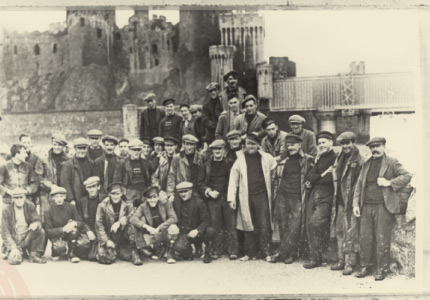
Here, in Conwy's cafés and private homes and pubs, hang treasured photographs where a man might proudly say, 'That's me – the youngest of all thirty musselmen!' or 'That was taken when the Walt Disney people filmed us!'
Early on in the project I recruited some writing volunteers to interpret the information we were collecting and turn it into poems and stories – one of my students was a marine biologist, and her tale 'The Trochophore Dance' is based on her scientific knowledge of the growth and development of mussels on the estuary bed.
With the help of Iolo Griffiths, the librarian at the North Wales Weekly News, I collected several press cuttings about the conflicts inherent in the business – from time to time there had been crises of confidence as the number of licence-holders declined and as the inspectors increased their demands. For Tom Jones, who runs the mussel museum on the quay, it is hard work, with stringent rules to abide by.
Yet as one looks across the river and sees Tom tootling over in his little motor boat to the full sacks on the pontoon, one is aware of the same fundamental traditions as of old, the same organic nature of the work, and the same proud lineage of the Conwy mussel fishers.
'Since I've been a kid I've always been a fisherman, and I've been helping out here for the last fifteen years,' says Tom Jones, as we sit on the wall in a cold spring wind on the quay at Conwy, squinting at the pontoon anchored a little way out.
'We fished for bass, mullet and salmon then,' he adds.
Tom saw how his father, Trevor Jones, fished for mussels with a rake.
'I became interested in it but had the opportunity to go to university when I was eighteen or nineteen, so I went, but always with the intention of coming back to fish in Conwy.'
Until then, Tom hadn't had much direct experience with the long-handled pitch-pine rake.
'I was taught by Ken Hughes how to throw the rake over the side of the boat and gently try to rake the mussels in, half a rake-full at a time. At first it was full of seaweed and sand but gradually I got the knack of it – raking has to be taught by an expert but it does come to you.'
Tom tells of how the mussel industry – growing and selling mussels – in Conwy has been flourishing for 250 years. 'Before that they fished for pearls, but the pearls have gone now and no one knows why!'
The Conwy Mussels building on the quay was designed specifically for the purification of mussels.
'After the move here from the old plant at Benarth, my father worked in partnership with fishermen Martin Parry and Francis Smith. There were nineteen fishermen at the time, raking and working on the river.'
The musselmen fish about half a mile out in the estuary in all weathers. The mussel beds are spread out across the estuary, where the water is a mix of river and seawater – part of the skill is in finding the mussels, Tom remarks.
'The mussels from deeper waters are larger, and they're black – what we call “black diamonds” – while others are tinted white or blue. Mussels take about three years to grow full size from the golden seeds of “spatfall” found in the shallows. It's a natural process; the mussels rely on bad weather to roll them into the deep to grow to full size.'
Tom's mussels are unique in the whole of the UK; they are hand-raked, as opposed to dredged or rope-grown. 'It's sustainable fishing, from a natural bed in the estuary,' he says.
'The mussels are pre-washed and bagged up on that pontoon,' Tom explains, 'and then brought ashore to the building. We sort them into baskets, before they are loaded onto a tray and lowered into a tank of seawater. They are cleaned for forty-two hours and then are safe to eat. They're graded, sorted and bagged, and then are ready to go off in the refrigerated vans to our main markets in Liverpool, Birmingham, London and Manchester.'
It's hard work, sometimes fishing at 3am on a winter morning, and every fisherman needs a licence.
'Costs are high, too, with rents, wages, running the tanks and so on. All we need now is a high demand,' smiles Tom confidently, getting up to see how things are going.
Ken 'Rimmer' Hughes
Renowned in the town as Conwy's oldest fisherman, Ken 'Rimmer' Hughes can still be found living in the street where he has spent all his life. Across the road from his pretty and comfortable home at 11, Berry Street, he can see the cottage of his grandfather, who was part of one of the original Conwy fishing families of recent history.
Surrounded by press cuttings, books on Conwy and a colourful portrait painted by Jean Morgan-Roberts for her book, The Character of Conwy, Ken, 87, points to the house.
'My grandfather lived over there, in number 14. He came here from Blackpool, along with members of the Craven family,' says Ken. 'They were fishing along the coast at that time and came into Conwy for shelter, then later settled here and married local girls.'
Ken's own wife, Denise, belongs to the Craven family, and also grew up in Berry Street.
'My grandfather started working with the mussels with the local fishermen – there were around fifty then. My father, William, and my uncles, Robert and John, became musselmen too.'
When Ken was fourteen, he joined the men of the family, starting work by picking mussels along the shore – and continued until his late seventies!
'I can't explain what it is,' he responds to the question of how he came to be doing the work for so long. It's clear from his knowledge of the river and the mussel beds that Ken's expertise is born of a real affinity with and love of the water.
The shape of the river Conwy may have changed as a result of the building of the tunnel, but when Ken hears varying opinions on the elusive character of the river, he confides, 'I just listen and laugh!'
'I was just an apprentice at first – learning how to use the iron rake and to wash the mussels,' reminisces Ken, who recalls that women would be working on the shore, picking and sorting the mussels.
'We'd pick their mussels up on the way back and then take them up to Benarth.'
Ken admits that he didn't really enjoy sorting mussels. 'It's hard, but people would laugh at you if you wore gloves! You'd bind a little strip of calico around your knuckles to stop them from being cut.'
Ken explains the process of fishing from the boat: 'The rake has a back on it so that when it's full you'd turn it around to empty the catch into the boat. They'd have to be sorted out – there'd be dirt and weeds – and the mussels had to be over two inches long. Then we'd put them into bags in the boat, and thirty or forty men would carry them up to the tanks at Benarth. There were three tanks, and we'd put the mussels in to be hosepiped clean, then the tanks would be filled with the purification solution. After the process was complete we'd shovel them all up and they'd be sent to market.'
Ken would go out alone, or sometimes with his cousin, Derek.
'Now and again there would be two in a boat, but more often just one. People struggled to buy and maintain their boat, but you had to have a boat of your own if you were raking. Later we'd have sixteen-footers with an outboard, which were built in Crossfield's Boatyard.'
Ken remembers going out in a fishing boat without a lifejacket in snow, wind and rain, often at night, and sorting mussels with water splashing into the vessel. 'Many a time there'd be an overload, leaving only a six-inch gap,' laughs Ken, who couldn't swim and can 'just about keep afloat' now. It was hard work, he says, but the men were all good friends and it was a very close-knit society.
'I still have a walk down to see how they're doing!'
John Keith Roberts
'As children we were always in the mussel tanks and boats and we never wore lifejackets!'
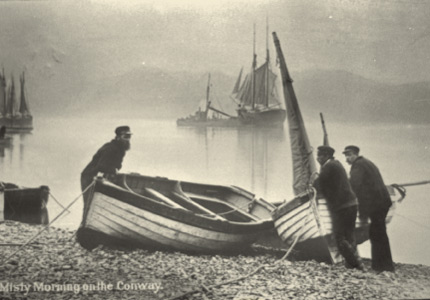 © Conwy Archives Service
From the age of ten, John Keith Roberts, now retired and living at Ivy Dene, Llandudno Junction, not far from the site of his memories of Conwy, was working with mussels.
'My grandmother lived by the quay and we were always there,' says John.
'It was hard but I liked it and we were brought up to it. I'd been doing it since I was ten. Three times a week, and at holidays and weekends we'd be there – all the kids did it and it was good pocket money!'
From that early age John had helped out with the mussels, shovelling them into the hundred-pound bags, and labelling them with their destination and the date before the lead seal was added.
Despite winning a further education bursary, John left school at fifteen to work full-time as a musselman. The mussel fishers by then had their own sixteen-foot mussel boats, and a motorboat towed the mussel boat out, although in John's father's time they had used a sailing boat.
'In the mussel-fishing season, which runs from September to Easter, we would go out on the ebb tide and return with the catch on the flood. You're looking for soft ground – you know when you come to a bit of mud: the mussels make mud. We'd be working for four hours, and the most severe conditions were in the winter in the mornings, when it was often freezing – but when you're young you don't feel it and it never put me off!' laughs John, pointing to a 1948 photograph of the musselmen in which he was the youngest of thirty fishermen. The photo is from the collection of Johnny Roberts, whose father John was John Keith's fishing partner for years. 'Johnny came with us, and worked with me,' adds John, recalling the 'glory days' of mussel fishing in Conwy in the 1950s and 1960s. 'That was around the time of the highest rate for shellfish and wet fish in Conwy, and when the highest numbers of mussels were caught,' adds John.
John's father, William, who died when John was seven, was from an old Conwy fishing family and had been a musselman all his life, one of the forty or fifty Conwy mussel fishers at the time.
'My father's father and my mother's family were all fishermen,' says John, who was born over what was Dunphy's in Conwy, where his family has lived for eighty years. It was a close-knit family, with his maiden aunts, Gwladys and Nell, also keen fisherwomen.
'I used to take them out every day – they wouldn't retire! Their job was to pick through and sort the raked mussels. They would come up from the quay in the early morning to go musseling and knock us up! We'd be on the beach at 5.30am with lamps, having a conference to decide if it was too nasty to go out. They never thought it was too bad!'
John fondly remembers how local musselmen would often hear the strains of 'Jerusalem' across the harbour, from singer Gwladys, 'The Welsh Nightingale', in full throat!
'They both loved mussel fishing, and not for the money. Nell could handle a boat quite well, but you'd have to watch with Gwladys – she nearly had me over more than once!'
In the heyday of the industry the musselmen were approached by the Walt Disney organisation to make a film, simulating the raking and picking of the mussels, which had a showing in the local cinemas.
John recalls the old boatbuilding families on the quay: 'good traditional boatbuilders' who would build new boats each winter. The Cravens, Roberts, Hughes and Jones families, who had their particular fishing beaches, would take summer holidaymakers out on fishing trips in their launches.
'We made a reasonable living, but there were some difficult winters when the mussels were scarce, depending on the breeding or on overfishing of the beds. We would go over to fish around Brynsiencyn, where we, the Conwy musselmen, paid for our own 'lay' while the beds replenished themselves. Natural reseeding takes place every April,' adds John, 'and Conwy is one of the few places with natural reseeding.'
John, who crewed for the Conwy and Llandudno Lifeboats until twenty years ago, has also represented the mussel fishers and their interest for many years, as chairman of the Conwy Harbour Committee and chairman of the Conwy Musselmen's Association.
John attended every meeting, and represented the mussel fishers for thirty years. 'We supplied boats for the Conwy tunnel work, taking inspection divers from the Welsh Office.'
John, who was also a member of the Lancashire and North Wales Sea Fisheries Committee and was still serving on the Committee at its recent centenary, remembers coming back often from musseling trips to change his clothes in the car before a meeting, while the other men went to the Liverpool Arms for a well-earned pint!
'The Committee supervised how fish were caught, and what size they had to be and so on. For instance, the size limit for a mussel was brought down from two inches to an inch and a half. It was a tradition that a musselman had to be on the Committee,' explains John. 'Also, we may get downtrodden and we needed to protect our rights!'
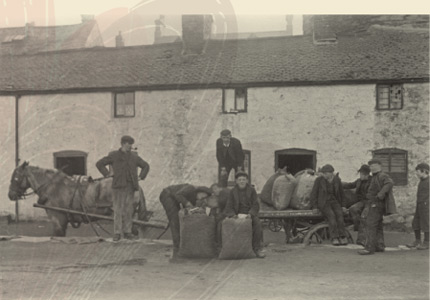 © Conwy Archives Service
I was just born that way.
But if you weren't, what would you be?
An astronaut.
And then?
I'd fly to the Moon.
For what?
To rake for mussels in the Sea of Serenity.
Under water they glisten
Shells like purple sea grapes
Succulent flesh
Edible ocean jewels
Lusted over for their pearls
Sold by the sack
Brian 'Porth Bach'
'God, it was cold!'
Sandy, the partner of musselman Brian 'Porth Bach' Jones, remembers with a shiver the times she tried musseling for herself.
'When we first met I used to go out in the boat with Brian. He'd say “Tell me when you've had enough” but I enjoyed it!'
Brian had been talking about his childhood living in the cottages at Customs House Terrace, near to Porth Bach, on Conwy quay: 'As a kid I lived in number 1, but I've also lived in number 2 and number 5!' Brian adds.
Sandy, who got together with Brian in the 1990s, and hails from Manchester, soon became an enthusiastic fisherwoman in the female tradition of Gwladys and Nell, the aunts of Betty Pattinson and John 'Dunphy' Roberts.
In those days, Sandy would go out to the mussel beds with Brian, where he'd leave her to handpick the mussels while he raked further off at sea.
'I liked it because you're concentrating, and it's peaceful,' Sandy says.
Later she would drive their Subaru onto the beach and help load up the mussels to take them to Bangor for purification, as the tanks at Benarth had long closed. Mussels were then taken twice a week by road to the agents. 'They'd ring and say how many bags they wanted,' says Brian, recalling how labour-intensive the fishing was in all weathers, handling the thirty-foot pole and iron rake on board, then loading up the heavy sacks.
A musselman from his early days, who 'wagged off' school to go on the boat at ten years old, Brian was following not only in the footsteps of his father, Llew, but also his grandfather and great-grandfather before him, part of one of the original mussel-fishing families in the town.
Llew musseled with his brother, Brian's Uncle Hugh, and out of the mussel-fishing season the men would work on painting the yachts or rowing boats, or go salmon fishing further upriver: 'The salmon season starts on April 1st and the licence lasts until the last day of August, so it fitted in well.'
The walls of Brian and Sandy's home in Cadnant Park are covered with photographs of the old days. In one a massive sturgeon lies on the beach, with Brian's proud relatives looking on in admiration, and there are numerous atmospheric and misty pictures of groups of musselmen or of sailing boats setting off on tranquil Conwy waters.
Brian explains that instead of using outboard motors some of the musselmen would hoist a sail on the little wooden boats: 'My father Llew used to sail to work, but others used the motor,' and, like many of the other fishermen, Llew 'never wore a lifejacket'!
Brian relates the story of The Smallest House in Great Britain, which was originally part of a terrace owned by his great-grandfather, John Jones. 'The whole terrace was condemned by the council but John insisted the small end one should stay, because of its size. They checked it out, and it was the smallest in the country! The rest is history,' laughs Brian, adding that Margaret Williams, who used to conduct the guided tour of the house, is his cousin – another example of how close-knit the Conwy families are.
It seems a romantic life, to set out to sea against the backdrop of Conwy quay, the castle and the houses of your forebears, working in an age-old industry with familiar and versatile comrades – 'The lifeboatmen were also the musselmen!' – where methods have hardly changed over the centuries, and Brian 'Porth Bach' has many fond memories, but also a tragic story to tell.
He'd been out musseling with his younger brother, Tony, in 1971. Tony, a student, was home on vacation from university, and the two were out by the 'Perch' in the middle of the estuary on a cold January day. After a couple of hours the seas became rough, the huge waves capsized the craft, and Tony was lost. Brian was rescued from the sea by musselmen from another boat, and his brother's body was recovered some weeks later.
Although Brian continued musseling, he has, understandably, never felt quite the same about the sea since, yet as he lingers on the photographs of his ancestors, it's plain to see his pride and the sense of fulfilment he feels in his roots, in having lived on this estuary edge for many years, and in having descended from Conwy's oldest and most experienced musselmen.
Betty Pattinson OBE
'I would probably have been a fisherman if I hadn't been a girl!'
Betty Pattinson, OBE, a Jackdaw, once mayor of Aberconwy, twice mayor of Conwy and the author of two books on her native town, recalls with pleasure her family connections with the Conwy sailing and fishing industry.
'Our family was known as the 'teulu hen fferi' (old ferry family). Was it an ancestor of mine, the sixteenth-century William ap Roberts, who complained to the Justice that his ferryboats were being vandalised?' muses Betty, adding, 'There was a ferry to Deganwy up until after World War 2.'
Betty's grandfather was a pilot to the sailing ships that came to harbour in Conwy, and hers is believed to be the oldest fishing family in the town, involved at first in pearl fishing.
Betty points to Rev Robert Williams's 1835 book on Aberconwy, where there's a description of the pearling industry (and an interesting spelling of 'mussels'!):
By 1939, Betty recalls, seventy-five mussel-fishing licences were held in Conwy, and the mussels were sent to markets all over the country; she still has invoices from Manchester, Birmingham and Bridlington.
'But during World War 2 the mussel tanks were closed because so many of the young men had been called up.'
Betty's brother, John, and her cousins were all mussel fishers.
'My father, William Owen Roberts, and his brother John and his family had a trawler, 'The Reliance',' explains Betty.
'Another trawler, 'The Sal', belonged to another family named Roberts,' she continues, adding, 'Different families had different beaches. Ours, the 'Roberts' beach, lay on Marine Walk, while Porth Bach was where the Jones family fished from, and the Hughes family and the Craven family worked from the quay.
'Mussel fishing is seasonal, so in the summer all the fishermen looked after yachtsmen's boats. They also had their own pleasure boats running river trips, and their wives took summer visitors – my grandmother, Elizabeth, did that.'
Elizabeth, a widow since 1900 and with two boys and five girls to care for, was steward of the Golf Club from 1908-32. 'She was invited to place the first shovelful of mussels into the purification tanks at Benarth!' Betty adds proudly.
In season, the mussels were picked and sorted by the women, including Betty's Aunt Gwladys, who helped her mother at the Golf Club.
'Welsh Nightingale' Gwladys was a renowned Eisteddfod singer, who belonged to a number of choral groups.
'She worked alongside her sister Nell and the wives of other fishing families as a mussel-picker,' recalls Betty. 'Gwladys and Nell were spinsters, both having lost their fiancés in the war. There were eight women who had earned their place in the fleet during World War 1.'
Gwladys loved the life of the mussel-pickers. Famous for her rich contralto, she enjoyed singing for the other mussel-pickers as she went.
An article on the mussel fishers of Conwy in the Daily Sketch of 1938, in the news because of their fears of a new waterfront road affecting their living, shows a picture of the mussel fleet and a view of the purification tanks. The article, which mentions how Lloyd George 'hurried to the town and met a deputation' and 'promised his support' includes a photograph of Nell – 'Miss N Roberts, famous member of the fleet' – and a picture of Gwladys, describing her as 'a well-known Eisteddfod singer' who 'always greets the returning fleet with a song'.
'She claimed it kept her alive and she carried on musseling for the rest of her life!' says Betty.
The mussel work gave Gwladys, who would be a chorister for seventy years, the freedom to take music lessons from the best teachers in Wales.
'But she had the thrill of her lifetime when 'The Reliance' was taken to Holyhead to be commissioned by the Navy and she was piped aboard!'
Johnny Roberts
Conwy's Johnny Roberts, who now runs the Gallery Café and gift shop with his wife Geraldine, retired from the mussel-fishing life around the age of forty, to create a steadier income for his family, as the mussel-fishing industry was by then in decline.
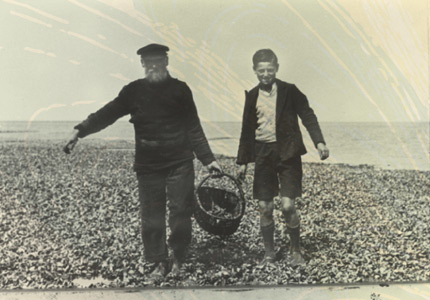
Pointing out a photograph of himself, his father and his 87-year-old aunt in a fishing boat, Johnny talks warmly of the renowned mussel-fishing families in Conwy – the Jones, Roberts, Hughes and Craven dynasties, of which he was the last Roberts boy to work in the trade.
'It was a foregone conclusion that I would join my father and grandfather – my father, John Lonydd, always said to me, 'There's a boat waiting for you!'
Even after Johnny's teachers had pleaded for him to stay on at 16, he 'just walked out of the school door and into a boat!'
From the age of eight, Johnny helped his grandfather, taking trippers out on the rowing boats. 'I knew the river and it was second nature to me,' he adds.
His father and grandfather were also licensed to fish for salmon in the summer, while musseling in the winter from the beds which lie at the mouth of the river – the mussels always feeding in the same place.
'Sometimes we'd be out at three or four in the morning, knocking ice off the rake and the oars. It was hard work, but a good living. A launch would tow four or five boats out, and there would be one raker and two gatherers in each boat,' says
Johnny, who was a gatherer. He remarks on how the mussels can vary. 'I could tell you where any Conwy mussel is from, by its size and colour. We'd put the mussels into bags and then they'd go to the purification tanks,' Johnny recalls. He remembers the great camaraderie among the fishermen, as well as the tough times when friends were lost.
'They were great characters and it was a good life – I'd go back to it tomorrow.'
Ronnie Ells
Memories from when I first started at the mussel tanks
Morris Jones was the Tank Superintendent; his word was law. Along with Jim Hudson, we were responsible for the cleansing process. At a later date, Jim took over Morris Jones's position.
Sadly, Jim had to retire, due to ill health, leaving myself with the position. It's easy to take orders but when you're faced with the responsibility of public health, and the livelihood of the fishermen, you have to play a dual role at work.
As to the tanks used for purification, three tanks were used, laid to a maximum depth of three inches, with the total volume contained within the tanks being 300 bags, at one hundredweight of mussels per bag.
So, how did the process work? Prior to introducing unwashed mussels into the tanks, seawater was pumped up into a reservoir containing 90,000 gallons. An oxidising agent was introduced in order to chlorinate the water, killing any active bacteria. This water would stand for twelve hours in order to do its job.
The mussels would be laid out on grids, and all the mud hosed off. A gap between the grids permitted all the mud to be flushed out to drain clear of the tanks.
Water from the reservoir was now introduced to cover the mussels for another twenty-four hours.
The 'Res' had to be repumped up ready for the final covering after twenty-four hours. The mussels would be rewashed to clear anything off, thus ensuring a clean shellfish prior to the final filling, when the mussels would stand again for a further twenty-four hours.
In the meantime, samples would have been taken to the Public Health Lab after twenty-four hours' purification, and only on very rare occasions would any doubt be expressed concerning their condition. After the final twenty-four hours it would be very unusual to get a bad result.
This process had proved itself over the years, and was used as a benchmark for the rest of the country.
To return to those past years, a visit by the Fishery Officer to inspect the quality of the mussels collected by the fishermen very often sent them into a panic in case he had other ideas – his word was final!
So, why did it end? Politics, perhaps – I was never told the true reason. And any future system had to meet the same high standards as had earlier been demanded by the Public Health people.
Ronnie Ells - The Site at Benarth
Benarth is located in an elevated position, which is important for the location and construction of the large containment of seawater.
Basically, three tanks were used. The lower tank housed the mussels, which were laid out on wooden grids to a depth of around three inches; this tank area was able to house three hundredweight in total. At a later date this area was divided into three separate tanks, each tank capable of independent working, to cater to demand.
The purification system required large volumes of seawater. The reservoir at the top level contained 95,000 gallons, which were pumped up by a gas engine in the early days, to be later replaced by two large electric ones. The centre tank was used to chlorinate the seawater, using an oxidising agent in powder form. The water would have been released from the tank at the high level, standing for about twelve hours in order for the chlorine to kill off any active bacteria in the water.
In the meantime the mussels would have been laid out on the grids by the fishermen. Tank staff would have washed all the mud and rubbish off, which was all flushed back into the river.
The next stage was to release the sterile seawater onto the mussels. A small quantity of neutralising agent was introduced with the water in case any active chlorine remained. The mussels would stay in the sterile water for the first stage of the process. The next morning, the water was released and the mussels would be re-hosed. Once finished, again the mussels would be re-covered with sterile seawater and remain for another twenty-four hour period until the day of 'sending'. Samples would have been taken to the Public Health Department to check for clearance, and the whole process took place under the watchful eye of the Tank Superintendent.
Unannounced visits from the Fishery Officer would be made many times a year and would send the musselmen into a state of panic – any mussel that was undersized (two inches was the given size for mussels) or deemed substandard would have to be removed and re-sorted (each mussel was sorted by hand) to his satisfaction. Mutual respect was in evidence from both sides.
Barnacles would remain on the shell, and this was accepted as being the norm for Conwy mussels. Only on very rare occasions would a merchant complain about it – in fact, it was a good indication that the product was from Conwy.
Full records were kept of the sendings, and a lead seal, along with a Ministry label, were attached to the sack at the point of despatch.
Over the years small changes were made: output started to drop, and the use of electrically-powered pumps did help in that a chlorinating tank could be filled in one pumping, sufficient to cater for a given quantity of mussels. The header tank was now being used in collaboration with the additional labs on site, and these labs helped nurture a good working relationship with the fishermen, and also helped to prove that the system was being constantly monitored.
 © Conwy Archives Service
Ronnie Ells - Personal Anecdotes
I remember standing there in an open tank with a hosepipe for hours on end, frozen stiff by the time I'd finished.
I was fortunate to be working alongside Jim Hudson, known as 'Jim the Tanks', who worked there for many years, prior to his ill-health. I like to think that between us we'd find the solution to any problem. Trying to take over his position and maintain his standards proved a challenge – it's easy to take orders but far harder to give them.
We once had a situation where the tanks were frozen to a depth of twelve inches. The sample had been given the all-clear, and the fishermen wanted to get the mussels out. If they drained the tank off they'd end up with the mussels covered in ice, so we actually flooded the tank from the 'Res', but the level increased as the ice broke up. Rakes were used to remove the ice from the surface, but by the time it was all clear we had ice everywhere.
Around the start of the season, the wooden grids used would need to be soaked well in advance, prior to starting work. However, on many occasions you'd be filling the tanks with mussels and up would come the grids. Salinity also often caused us problems at times of high water and small tides. Tides don't respect anyone – and the need to repump the tanks and chlorinate the water as it went in often meant crazy hours spent there.
Steve Lockwood was in charge for a while and I like to think he did play an active part in many ways, even though his role was on the lab side of things.
In the early days we had a shed for our distribution of sacks to the fishermen and to take the fees for the service. Cash would be housed in a wooden drawer, with the only form of security a six-inch nail to trap it shut, and everyone knew this, yet never once was it touched.
Very often you'd find yourself having to play a dual role in the job – against the Ministry on one hand or against the fishermen's interests on the other; piggy in the middle, so to speak.
Every 'sending' needed the OK from the Public Health Department. On occasions you'd get a Grade 2; however, because you'd taken a sample after twenty-four hours it was nearly always deemed safe to release for market. At other times, during the spring and when water temperatures would start to rise, spawning would take place. At the start of the season the high water temperatures would also cause the oxygen levels to drop to below what we knew to be harmful, but the use of a spray helped to lift the levels back up again. Experience played a part – you knew by looking at the mussels in the water. It's difficult to explain how you get to know, but it happens when you spend so much of your working day handling mussels.
The Colcon Project posed what seemed a major problem – due to the dredging of the river there were very high levels of suspended solids, and at first it was thought impossible to purify the mussels in that dirty water. However, it was decided to give it a try, and looking at the effects, it soon proved hopeful; the mussels filtered the cloudy water to normal in a very short time. The health checks were OK, and we even started to use mussels in the labs to clean water which no known filter could handle!
Ronnie Ells - Reflecting on the Fishermen
They were hard men; they had to be, as boats had to be sculled out to the beds. I defy anyone today to try and return home with a full load of mussels – there may be an easterly breeze against them, as well – and once back at Conwy, start to 'pick' as it was known. This could take many hours; there were no machines in those days. The mussels would have been brought around, close to the station at Benarth, ready for the next purification to take place, once the previous purified mussels had been despatched. Then the process started again.
So why did such a proven system have to end? A combination of politics and new methods coming online, such as at Conwy today; the housewife was now wanting a product that looked cleaner and was packed in ways more suited to her needs. Ironic, isn't it, that prior to the closing of the mussel tanks at Conwy, any future purification station had to meet the same high standards that Conwy had given throughout its service.
The fishermen were all members of the Fishermen's Association. Dr Eric Edwards, respected by every party, had over the years proved his value, not just to the fishermen alone, but the merchants too. Also worth mentioning are the carters who took the product to the markets – for many years it was Roland Young who provided the wagons, driven by 'Our Terry' who, as far as I remember, never once let the fishermen down. This does deserve thanks and to be noted.
So, how did I feel once I knew the tanks had to close? At first, I found it so hard to believe, and tried to defend the site, but many facts were aimed against us, with the final blow being the threat of contamination by seagull poo!
Very little evidence remains on-site as to its past use. However, when I walk around I do see odd things which give a hint of its use in past years. A visitor may get some sense of what has been described here, and needs only see a fisherman using a rake to remember that he is only doing what his forefathers did before him.
Ronnie Ells - Further comments from Ronnie in October 2013:
Following on from our conversation about the past purification system, I feel it is only right to add one's admiration for the musselmen themselves, who would go out on the ebbing tide to the beds of mussels.
The old wooden boats were heavy and there were no outboard motors – they may have been towed by a launch, and would spend an average of four to five hours either picking by hand or using rakes in deeper water. This might sound old-fashioned but the method remains. The lads that go out today, though low in numbers, still have to face conditions that would make the landlubber shiver in fear! Imagine it's a freezing cold morning, with the wind blowing, and you have to go out there in an open boat, cold and wet, with hours of hard work ahead. In days gone by there was no protective clothing, or fancy showers and central heating to come home to! We still talk of those times gone by and those hard, tough men, yet every one was a gentleman.
Gareth was watching small crabs busy foraging between the shells and sea anemones inside the small rock pool on a beach. He noticed some mussels open and close their shells.
'Megan, look, look! Mussels clap!' he shouted to Megan, his eight-year-old sister who was looking for flowers not far from the tidal pool.
'They have released some poo!' he laughed. 'It's pink!'
'Oh, silly boy,' thought Megan. She was a year older with airs and graces, but she loved everything pink and came to look at it.
Some mussels had their shells open wide and puffed milky clouds. Then pink clouds of something arrived from other mussels. Soon the water turned more pinkish and cloudy and they could see nothing through it.
'You are a fool, Gareth, this stuff is not a poo,' she said.
'What is that then?' the boy cried.
'I shall ask Mum,' decided Megan and they ran towards the small tent behind the sandy dune.
'Good, you are just in time!' their mother greeted them, as the first drops of rain fell.
'A thunderstorm, a thunderstorm!' cried the children.
'Mother, Mother, the mussels are puffing pink and white clouds. What are they?'
Their mother was a marine biologist and she knew everything.
'April is the spawning season for mussels. Possibly you saw them releasing their gametes. A thunderstorm could trigger it,' she replied. 'Not many people are lucky enough to see that annual event.'
'The clouds are different colours. Why?' Gareth asked.
'There are two types of gametes. Female eggs are pinkish, while the male have a milky appearance,' their mother answered.
The rain stopped and the children ran back to the pool to see what had happened. The water had cleared, but a pinkish substance covered the small rocks and algae and the whole bottom of the pool. Small crabs were starting to eat it.
'Children, our time is up and we are going home; the tide is coming in,' their dad called.
The children were so tired from their day on the beach that they went to bed earlier, but the excitement of the mussel spawning kept them awake.
Megan and Gareth had never been interested in mussels before, but they had been fascinated watching the crabs picking their food and carrying the algae on the top of their shells. Up until then, the unattractive clusters of mussel shells covered by barnacles had been just a nuisance, preventing them from climbing the rocks barefoot, which they loved to do.
Yet, that evening, instead of the usual fairy tale, they asked Mother to tell them more about mussels and what would have happened to the eggs. Would the crabs eat them all?
'Don't worry; the incoming tide will wash the fertilised eggs away. The crabs won't eat everything. One mussel female releases hundreds of millions of eggs; this is a part of their survival strategy. One single egg is much smaller than the point of a needle. You can only see it under a microscope. After fertilization embryos start developing and go through what we call 'blastula' and 'gastrula' stages. On the 'blastula' stage they begin to rotate. In just twenty-four hours an amazing transformation happens, when larvae reach the 'trochophore' stage and start to eat plankton, the tiny algae that float in the water. These larvae have a mouth, so they can eat. They also have internal organs, a stomach, a nervous system and even a simple eye. A band across their body consisting of two rows of cilia helps them to swim freely. Just think about that! 'Trochophores' have a transparent, diamond-shaped body, and they also have tufts of hairs at the ends, which help them feed and flow freely, and swim and dance their unique dance…' recited Mother, but the children were already fast slept.
Megan dreamed that she was sleeping on a shore in a tent. Gareth was next to her. The big rock covered in clusters of mussels was above them. The mussels themselves were nearly indistinguishable under the layers of barnacles on top of them, but Megan could somehow see what was inside their shell. The tide was out; it was very quiet, except for the seagulls' cries as they fished far out at sea. Then a strange, soft cracking voice rose from the side of the rock.
'Today it is my turn, ladies and gentlemen. We have been sitting here together for years; the only thing that changes for us is the tide. In low tide we keep our shells tightly closed; when the tide comes up we open up and filter the water to catch our food. The barnacles are a hassle; they catch some of our food, but they do give us good camouflage from our predators. Let's admit it, our daily life is boring. But we have all had our moment of joy. My most precious memory was my first dance as a young 'trochophore'!'
Other voices rose in a chorus all around, filled with sweet nostalgia.
'It was such a short period that I don't remember much. My most exciting moment was searching for a substrate to settle on,' said somebody else, moving its gracious foot inside its shell.
'I loved the time when transparent armour covered my body and protected me from greedy predators. You know that myriads of our brothers and sisters were eaten,' said other.
'You are all right. Yet, I want today to remind you of the joy we felt when we were 'trochophores' and swam towards the light,' the first voice sounded again. 'I saw myriads of you, all wearing tutus of different colours, from gentle pink to cloud blue and salad green. We were blissfully dancing in transparent water, rotating and floating in different directions. I quickly learned how to use my tufts of hairs to turn myself upside down. My body was iridescent as I rotated, moving towards a bright orange object above.
'I will never forget that moment. Yes, it was a short period. I felt intense tension between the different parts of my body that were growing and changing rapidly. The light above dimmed, it became dark, and then it was light again. At that time I was much bigger and already had protective armour around my body. My beautiful tutu disappeared and a large sail rose from my shell, helping me to navigate. But I never forgot my first and last dance.'
The crackling voice stopped and everything was silent except for the sound of the incoming tide.
'I must wake up and fold the tent before water comes in,' Megan thought in her dream. Yet, when she opened her eyes, she was not in a tent but in her own bed and Gareth slept soundly in his bed in the same room.
'It was a dream!' she said aloud. 'I must ask Mum more about mussels. How is it possible that such beautiful creatures could become such boring, passive adults!' And as she said this, she knew already that a mussel's life is not boring, but complicated and full of adventures.
 © Conwy Archives Service